MSc2 Chair of Public Building and Architecture,
TU Delft
Featured in:
ARGUS ARCHITECTURE ANNUAL 2015 – 16 (TU Delft Select Projects)
concerning itself with:
Resolution, scale, sense of scale, ergonomics, variable public space
Excerpt:
Processes:
Mapping processes – Site resolution study, Street Section Abstracted, Street Section Abstracted – 2, Elements along street abstracted, Elements along Street Study.
Modelling processes – Abstraction of Mappings into Materiality, The abstraction of mappings into material tectonic expression
theoretical processes – Imposition or In Position 1 & 2, Creating space, Theoretical thinking via a Cubist Approach
Programmatic considerations:
incubator/study space vs playground/public space
variable spaces in constant flux that are defined by ergonomics.
The project attempts to increase the Resolution of architectural elements along Straße des 17. Juni in Berlin via the design of an imposition.
The street itself designed as an imposing axis, primarily serving cars and favoring the vehicular over pedestrians, ignoring the many whom inhabit the spaces (universities and offices) along the road.
Resolution and Imposition measured via units of Human affordances and ideas of Variance.
Resolution as the provision of greater architectural objects and elements that participate in the human understanding of space; from possible elements as furniture, boundaries and/or shelter.
The imposition itself defined and directed by the understanding that human affordances (ergonomics) define our experience and the perfomative capabilties of all architectural elements. (i.e our bodies define how we understand and use spaces.)
The imposition, an assemblage of a network of phsical elements that when composed proviced a variety of experiences and understandings unique to each individual who visits the site.
The imposition was also designed to function as an invariance, ensuring that the site would be redefined by this new characteristic manner of understanding space while functioning as a landmark, creating a sense of place (in the Christian Norberg-Schulz sense of the word).


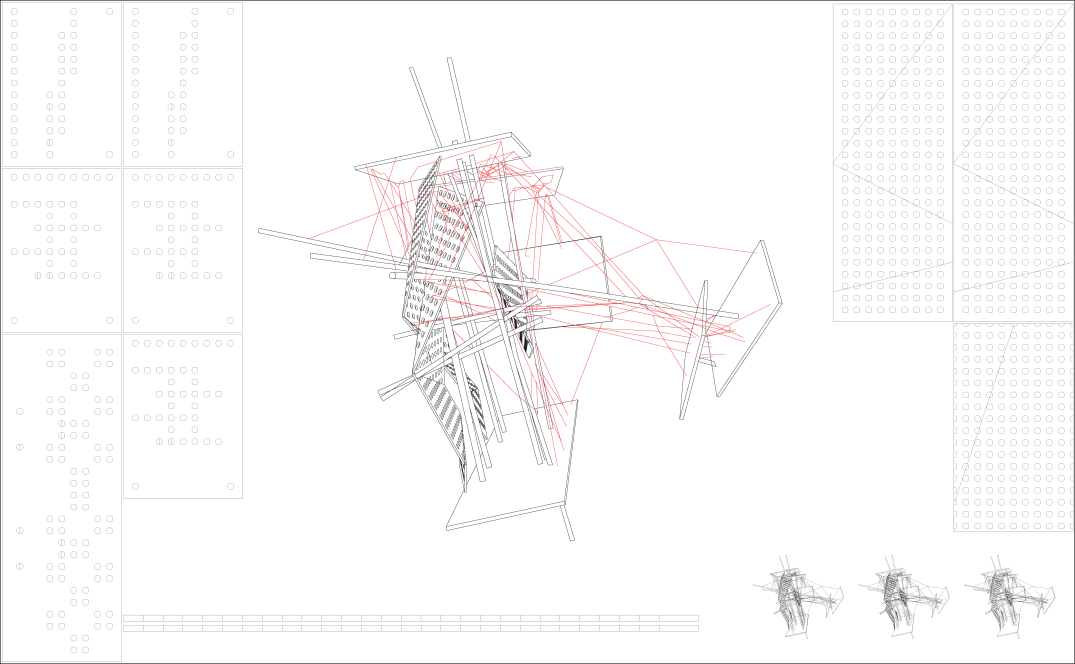


IN(M)POSITION:
The Project revolves around ideas of Resolution, imposition, which itself is taken measure via the units of Human affordances and ideas of Variance and Invariance.
Straße des 17. Juni in Berlin, Germany, more specifically, the pedestrian walkway in-front of TU Berlin was chosen to be the hypothetical site for the exploration of these ideas.
Conceptually ideas of Resolution were drawn and understood via ideas of the pixels on a screen and then translated into the site (Site resolution study), while ideas of the tension between In Position and Imposition were eventually understood to be a matter of a person’s perspective (In Position or Imposition 1 & 2). This idea would be transposed into spatial understandings via undertaking the notion of Human affordances, where ergonomics and proportion of person to space defined perspective.
Resolution is then discussed architecturally as the provision of greater architectural objects and elements that participate in the human understanding of space; from possible elements as furniture, boundary and/or shelter (elements along street studied).
Simultaneously, in attempt to find an architectural expression to house and manifest such ideas, the street itself and its adjoining streets were mapped and redrawn to identify possible approaches and patterns that exist on the site (Street Section abstracted 1 & 2, Elements along street abstracted).
These findings were transposed into an abstract model, in attempt to manifest some notion of context and site (Abstracted applied, The abstraction of Mappings into material tectonic expression).
The manner in which these elements are assembled was undertaken with the understanding that these human affordances and Imposition which define the experience and performative capabilities of these architectural elements within the site.
The abstract model provided an architectural expression and tectonics that encapsulated the ideas of Human affordances and the tension between In Position and Imposition. The tension articulated is as comparable to that of a Cubist Painting, where an attempt to draw the multiplicity or entirety can only result in an abstracted reality of unbeknownst possibilities (Theoretical thinking via a Cubist approach).
This resulted in the assemblage of a network of physical elements (which takes the form of cable like elements and floating planes, in Elements) which when composed provided a variety of experiences and understandings, unique to the individuals on site. This meant that the same composition of line and plane is understood differently depending on the individuals perception of space. Therefore, imposition is not understood as a dictative action, it is understood in this project as a receptive action where the individual imposes the program/understanding onto the physical architectural elements that exist on site (Long section 1 & 2, Section Close ups 1, 2 & 3). Thus these elements exist across a range of human affordances, and posses the possibility of being different across different groups (Perspectives 1, 2 & 3).
While maintaining ideas of variance in its understanding as a space(or a series of spaces), the project attempts to define the street via the insertion of Resolution by having the design been placed in position as defining the street. Thus the project was designed to have elements of invariance, to ensure that Straße des 17. Juni would undertake or be given a possible new character as a landmark or sense of place (in the Christian Norberg-Schulz sense of the word), while also employing the invariance as tactic in manipulation flows of human and vehicular traffic on site. Here manipulating the density of the lines and planes on site allowed for clear forms that influenced human explorations through the design project.
Studio Mentors:
Dr. Sang Lee, Micha de Haas
Click on the squares below to jump to their respective projects.

 ALVIN CHEW