Y2S1 SCHOOL OF DESIGN AND ENVIRONMENT,
NATIONAL UNIVERSITY OF SINGAPORE
concerning itself with:
context, rebuilding and building context, history and the projection of history, perception of history.
Excerpt:
Processes:
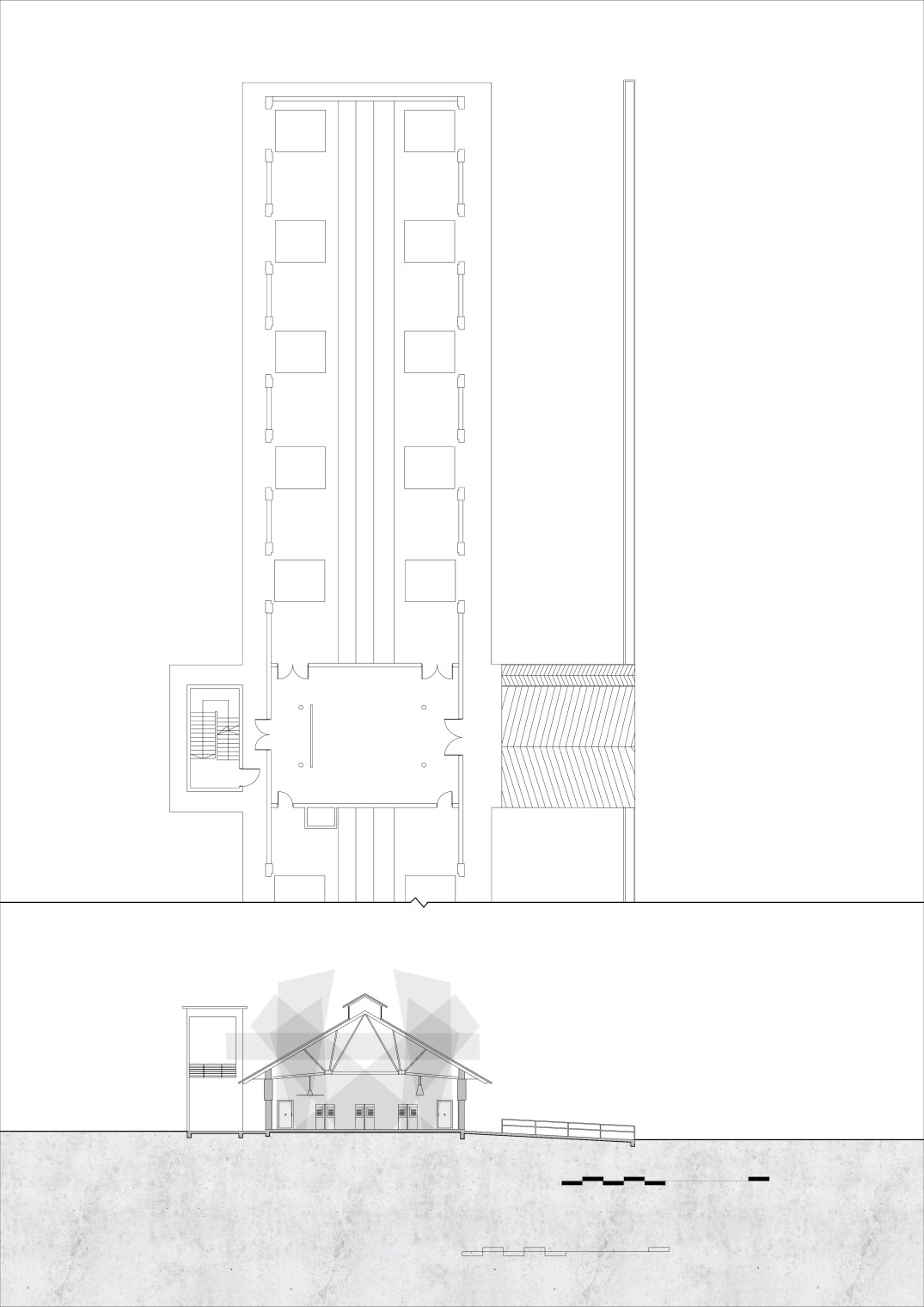
Theoretical processes – Shed Redrawn, Thinking of Modern Ruins as Fossils, Conceptual Thinking – (Re)building Dairy Farm
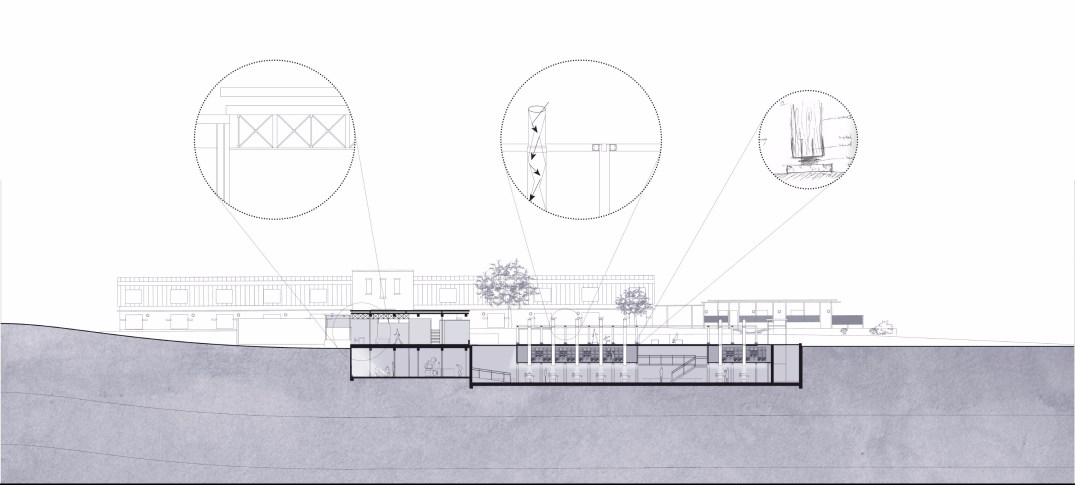
Projective processes – Shed as it is, Column Foot Sketch Type 1 & 2, Long Section 2 with Architectural Features.
Programmatic considerations:
digital data farm, museum
Memory as influencing and projector of space.
In responding to the brief’s requirement of creating a museum, I proposed a reading of the site and the design as a reading of layers itself , where different levels of the design reflect the different interpretations of how history should be perceived.
In addition to the given brief, the Studio Mentor also encouraged us to interweave a chosen narrative from a work of literary art, and for this project, Jack London’s “Call of the Wild” was selected.
The narrative of the story where carcasses were employed for survival as shelter, heavily influenced the approach towards modern ruins as fossils and carcasses that could also be used to ensure the survival of a certain historical narrative.
The design thus appropriates the left behind elements, modern-historical ruins, as markers or influencers of the design process and the eventual design. This allows the design to be a critical statement on the manner in which Singapore often erases all forms of history to reinforce the chosen narrative of their time.
The design was influenced by the idea of the palimpsest, where layers of history left behind are assimilated into the designs of the future.
The footings and ruins became assimilated as all part of the architectural elements that defined the design and spaces, allowing the design to balance and question the differences between the old conserved against the new.






In light of Yesterday, for Tomorrow:
The project employs Dairy Farm Nature Reserve in Singapore as the location for the hypothetical experiment.
The site was home to the dairy farming industry in Singapore during its colonial and early independent years, and was thus named Dairy Farm. Presently, the industry has ceased its operations and the existing buildings on site have been conserved and reprogrammed as part of an education center bearing the name of a prominent figure in Botanic History both locally and internationally. The main functions and programs of this Education Center (named Wallace Education Center) are housed within the restored Cow Shed, which exhibits both information on the findings of Wallace and his History.
This marriage of History and Nature, housed within a re-purposed barn prompted the desire for an alternative means of dealing with the modern ruins left behind on site.The existing site today has strong ties to Nature and history, alluding both programs and activities to historically-nature related elements but ignores the history of the site as having manipulated nature through agriculture.
The site holds a variety of Modern ruins, from left behind column footings to the stairs of the raised platform from which one feeds the cows through troughs (column footing type A and B, Shed Redrawn), allowing the possibility of a diverse reaction to modern ruins.
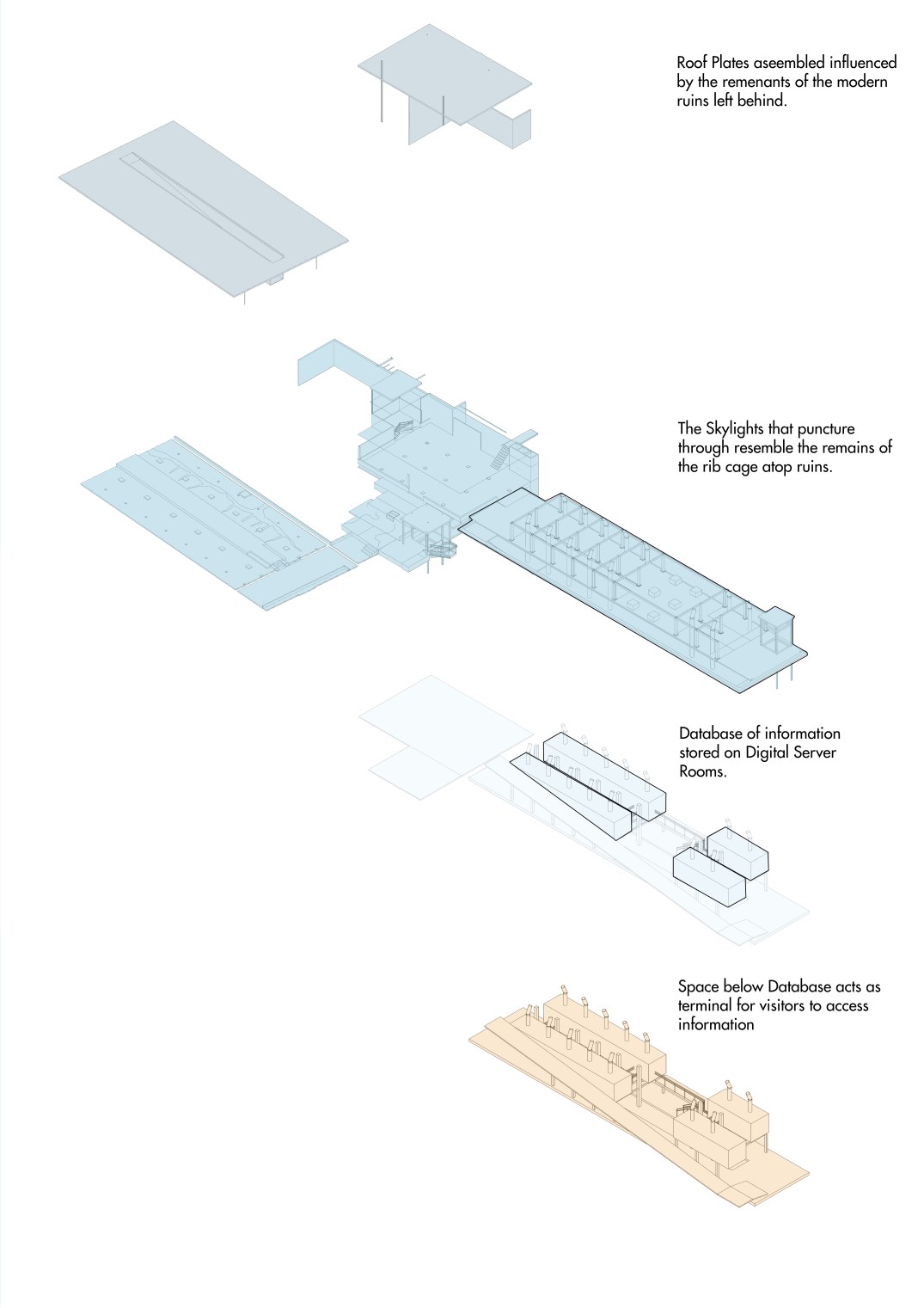
In responding to the brief’s requirement of creating a museum, the program was personalized as a museum / archival building that converts and archives information regarding the Agricultural Industry digitally, while allowing the public to access information in digital terminals freely on site. In addition, offices for staff to both run the premises and collect research and information on the Agricultural industry of Singapore.
In addition to the given brief, the Studio Mentor also encouraged us to interweave a chosen narrative from a work of literary art, and for this project, Jack London’s “Call of the Wild” was selected.
The narrative of the story where carcasses were employed for survival as shelter, heavily influenced the approach towards modern ruins as fossils and carcasses that could also be used to ensure the survival of a certain historical narrative.
As a conceptual idea it was a museum that grows from the histories that it collects. Architecturally this idea would materialize in the manner the new additions atop the modern ruins suggest a tension between continuity of growth from old to new and the total creation of an unrelated new, within the assemblage of the two.
The museum balances the spaces underground with spaces above ground that both accentuate history and nature in Singapore.
Imprint of columns and footings found at site like fossils left behind, coupled together with skylights, influenced by the Barn left behind (Section BB1), that are cut out from existing ground and extruded – forming image of an animal’s carcass or rib cage (as seen in the Approach Drawing and the Perspectives).
The skylights provide a dramatic play of light below ground in the day, while at night illuminates the surroundings above.
The procession through the design also reinforces the tension of moving forward and looking back, via the lens of history, with a regular reminder through the constant acknowledgment of old and new through the program’s corridors and axes.
Old and New is then read as distinctly different yet assembled to suggest a greater architectural experience.
Studio Mentor:
Dr Lai Chee Kien
Click on the squares below to jump to their respective projects.


 ALVIN CHEW