Masters Graduation Thesis, TU Delft
concerning itself with:
Sampling, Place transcending locality,
reappropriating typology, Redefining place as determined by space, Reordering, Fragmentation, Multiple Modernities, Case for the subaltern, Assemblage, Projection.
Excerpt:
Processes:
Mapping process – Range and field of intensities, Physical Suspension, Suspens(e)ion
Modelling processes – Modelling suspension, Architectural Expression Model
Ordering Process – Site Model, Fragments as Fragments
Sampling process – Fragment A, Fragment E, Fragment E underbelly
Programmatic considerations:
Reformative school for
Drug addicts vs
Public space.
Contest for dominance,
tethered throughout.
Focused around Sampling and Mapping as tools for creating architectural experiences that defined space and form.
Non-totalitarian, non-prescriptive manner of studying a specific part of the city of Bucharest, Romania from the ground up through the drawing and re-drawings of maps that objectively catalogued my subjective interpretation.
The mappings inherently suggested an attempt at dealing with the city’s collective memory, allowing for nuanced changes that created spatial experiences that hijacked perception, allowing for a contest of dominance between space/materiality/program.
This approach favors the study and creation of spatial experiences which were founded or focused upon the collective memory and understandings of space by inhabitants of the city.










An Architecture Of Suspension:
The project employs the city of Bucharest in Romania as the basis for hypothetical exploration.
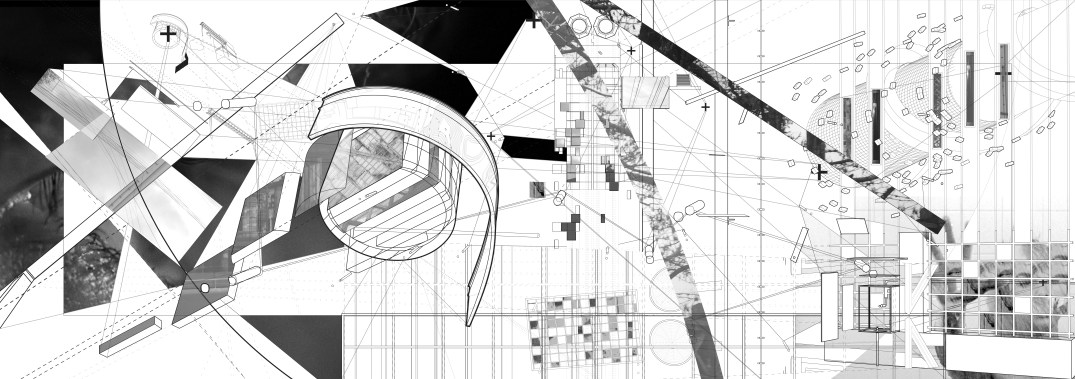
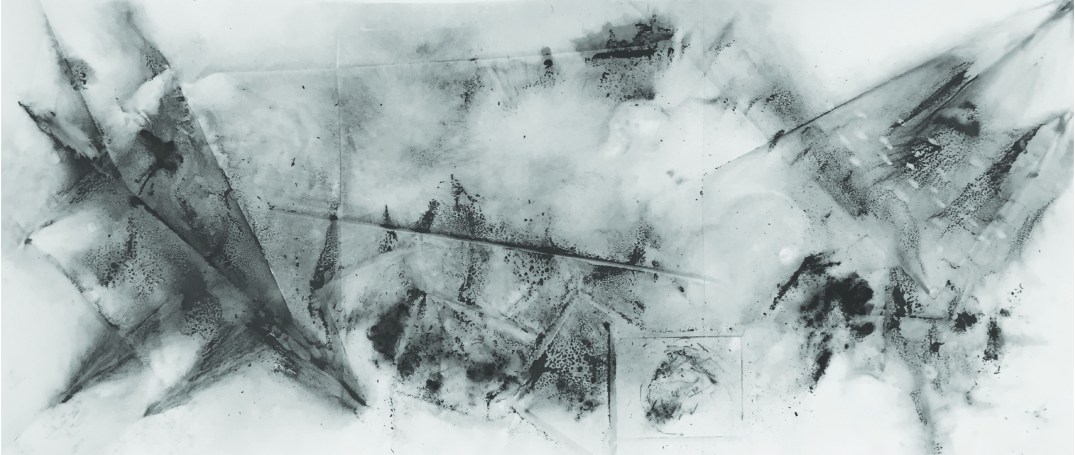
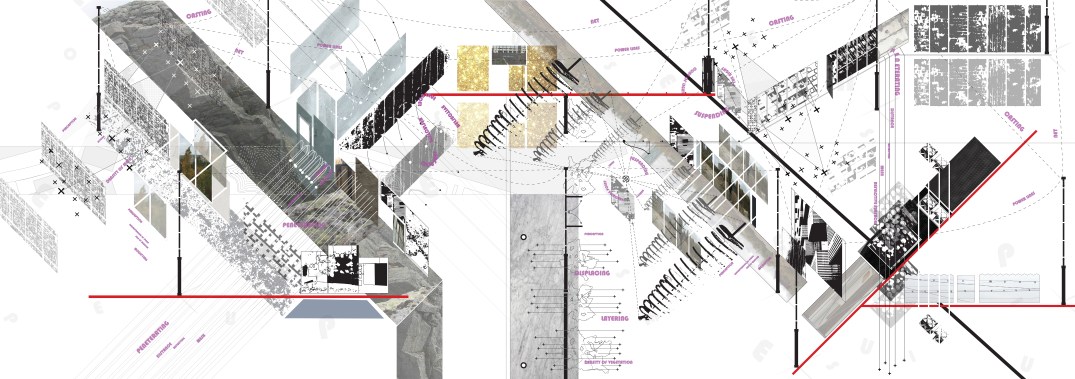
After Extensive Mapping of the area of Morarlilor in Bucharest, drawings (Suspens(e)ion, Range and Field of Intensities, Chemical Suspension, Physical Suspension) regarding the observations made of that particular part of the city, birthed the conceptual idea of an architectural phenomenon that was then termed the Architecture of Suspension. Those observations were made from a bottom – up drawing and re-drawing of observations from an architectural lens, eschewing the prescriptive and top down approach. The observations suggested that the city operates as a collection of multiple modernities, with these modernities negotiating with each other, at times clashing and at times totally ignoring each other.
The Architecture of Suspension is termed to discuss the effects of place and notions of place arising from architectural typologies. It suggests the idea that architecture can transcend locality, creating alternative experiences to known spaces and programs. Specific landmarks were chosen then to experiment upon and discover the potential of such an approach.
The specific landmarks in the city were chosen due to their accessibility, to as large a proportion of the city as possible and thus encompasses a variety of types. This was cataloged in the drawing titled References. The variety of these landmarks include, Gara de Nord (train station), Politehnica (metro station), Carol Park (public park), Romanian Athenaeum (cultural venue with political undertones), Palace of the Parliament of the People (historical communist dictatorship), Antim Monastery (religious) and Turnul de Arta (Modern day artistic criticism).
Parallel to the selection of the landmarks, the project developed its brief, responding to the main observed issue of the city; the crippling and divisive drug problem. This brief resulted in a selection of a design site and program; the site an empty plot 400m from the main train station – Gara de Nord (where drug addicts have been known to congregate), and the known program a reformative school for drug addicts. From that a study into how drug addicts experience the world resulted in drawn expressions (Architectural objectives 1,2 and 3) that would help influence the design of the next phase.
A study was done of the chosen site, with an attempt to respond to the context of site via the known abstractions from the research drawings. Thus injecting Suspens(e)ion, Physical Suspension and Range and Fields of Suspension into the site’s physical characteristics and context.
Eventually the two separate approaches (abstracting landmarks and abstracting observations) when projected onto the site manifested in a research model that allowed for the experimentation to achieve an architectural expression that suggested a manipulated (from the landmarks) typology that allowed for the operation of the architecture of suspension.
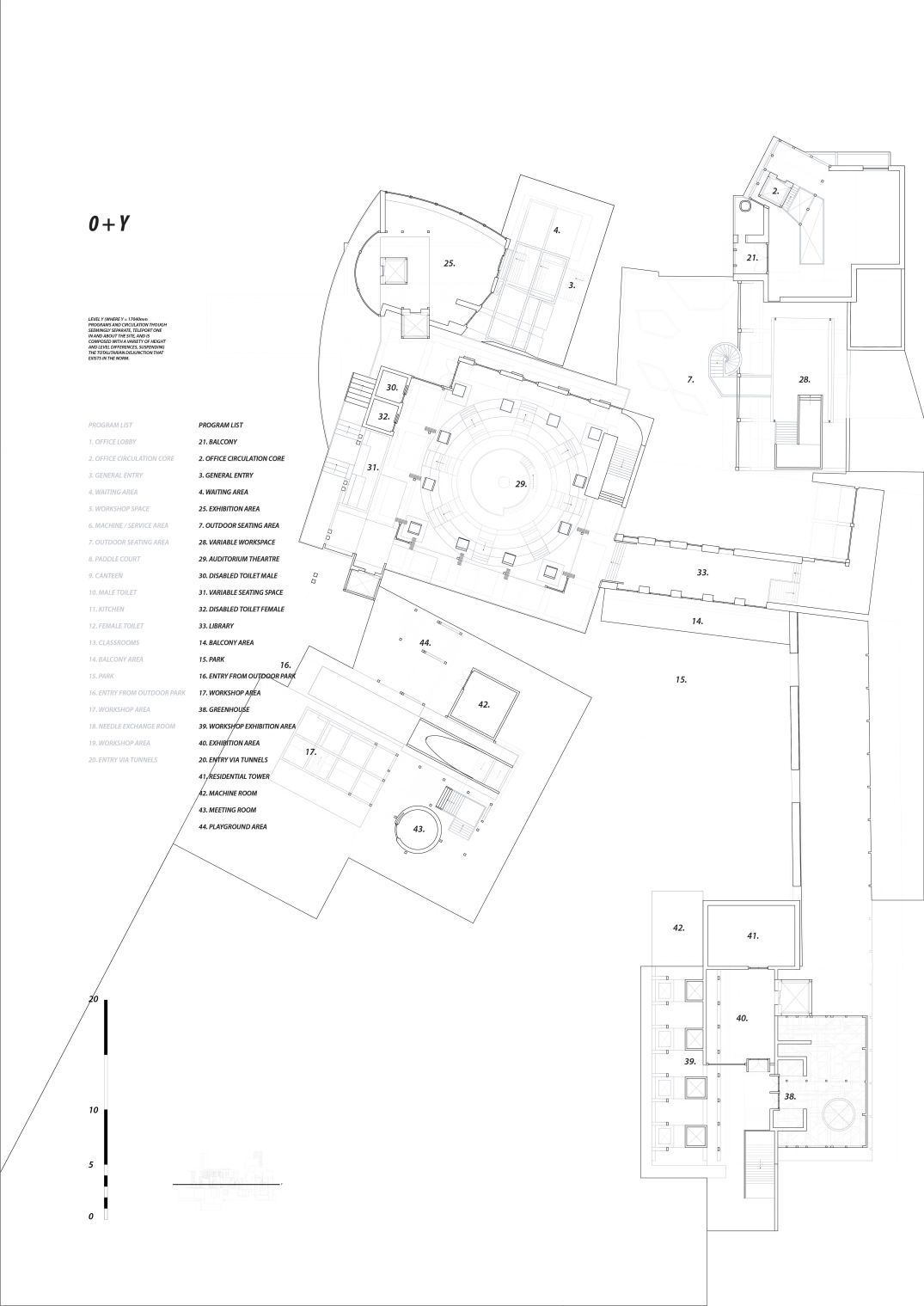
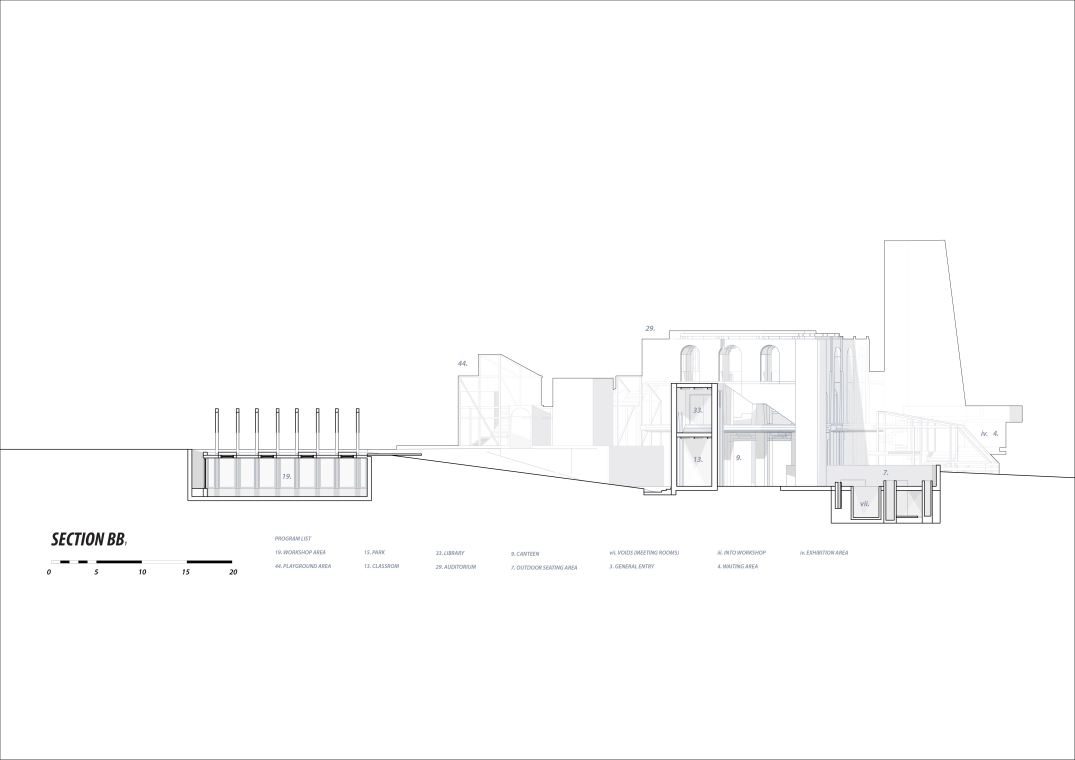
The research model was eventually fragmented into a series of flat planes, which when reinserted with program allowed an alternative reading of known understandings of the relationship between program/space and form, it also further allowed questioning of the multiplicity of space and clashes of program; spaces designed were then always a range of possibilities, never a single determined or prescribed space. These planes were then used as the basis to project spaces and forms that reinforced the manipulated typologies.
These planes resulted in 7 fragments (A, B, C, D, E, F and G) which when reassembled according to the programmatic considerations resulted in the eventual assemblage that is the design.
For further reading on how the theoretical framework was explored from a word oriented process, see:
FRAMING AN ARCHITECTURE OF SUSPENSION
The following drawings were drawn in collaboration with Shin Dong Woo:
Suspens(e)ion, Physical Suspension and Range and Field of Suspension
Dong woo can be reached at: sdwarcht@gmail.com
Model photographs taken by Marissa van Dorp,
http://marissavandorp.wixsite.com/photography
Studio Mentors:
Dr. Marc Schoonderbeek, Oscar Rommens, Pierre Jennen, Dr. Sang Lee
Click on the squares below to jump to their respective projects.

 ALVIN CHEW